RFO Measurement Technology
The T9740 uses the RFO (Restricted Flow Orifice) method, a proven and reliable technique for measuring flow through calibrated orifices. This system is based on the correlation between the pressure difference across a calibrated diaphragm and the flow passing through it. Unlike traditional volumetric methods, the RFO system guarantees high stability and repeatability over time, with minimal performance drift. The standard electronic pressure regulator ensures that measurement conditions are always optimal and constant, eliminating variations due to supply pressure fluctuations.
Available Configurations
The T9740 offers five different flow configurations to adapt to various types of components to be tested: 0-10 l/min, 0-20 l/min, 0-50 l/min, 0-83.3 l/min and 0-100 l/min. Each configuration maintains the declared accuracy of 1% of the reading plus 0.1-1% of full scale, ensuring reliable measurements across the entire working range. The possibility of combining differential pressure sensors with different ranges allows for performance optimization based on the specific characteristics of the components under test. This versatility makes the T9740 suitable for multiple industrial applications, from automotive components to precision hydraulics.
Process automation and control
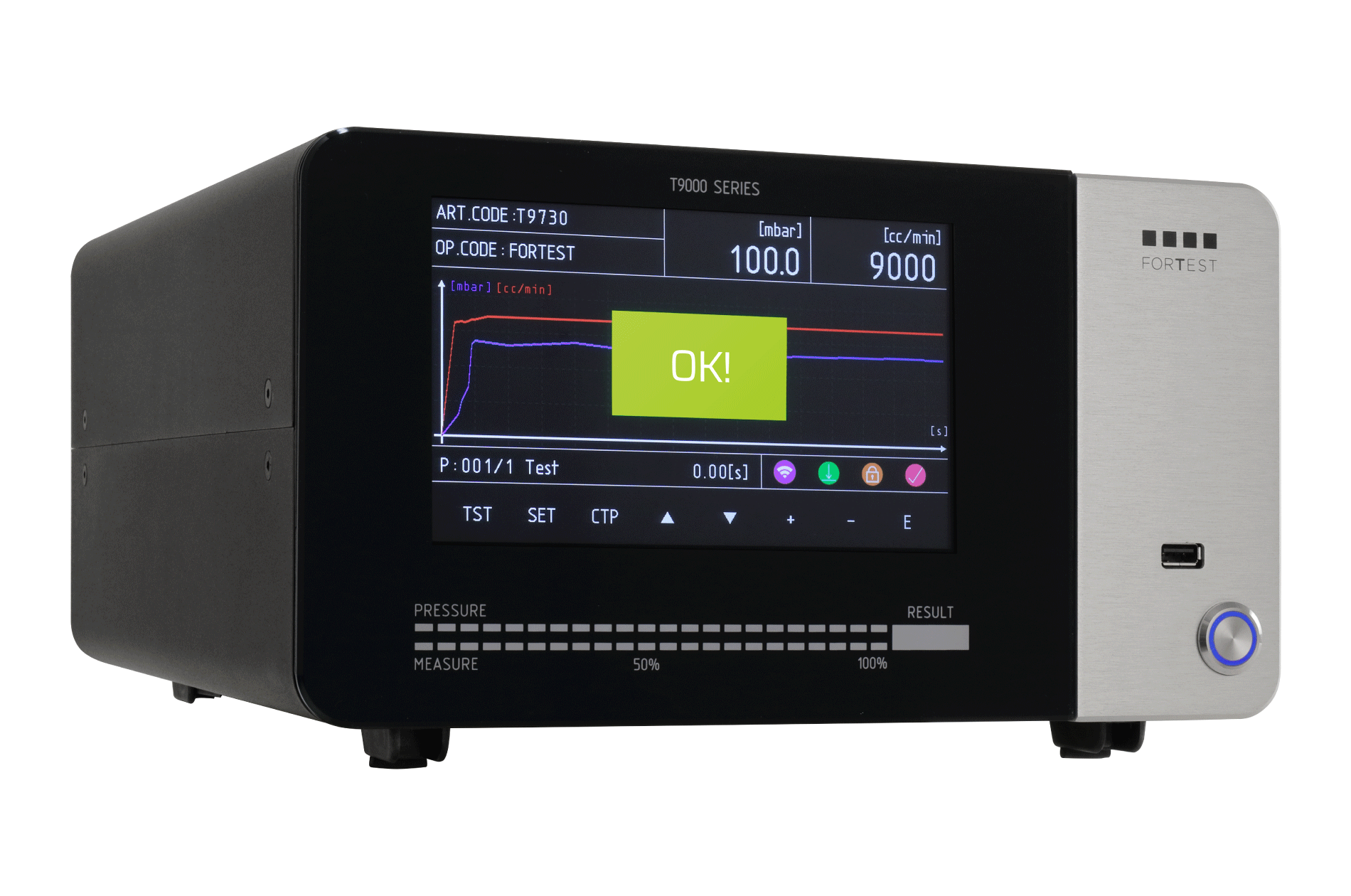
The operator interface includes an 800×480 pixel color touch screen display that allows simple and intuitive management of all test parameters. The equipment can store up to 300 different programs, each identifiable with a 16-character name to facilitate recognition. The password protection system prevents unauthorized modifications and ensures the integrity of quality control processes. Standard I/O signals include Start, Stop, Filling, Test, Good, Reject and 4BCD for integration with automation systems, while an optional module adds 8 programmable outputs and 4 programmable inputs for more complex control logic.
Standard Equipment and Advanced Options
The T9740 comes standard with electronic pressure regulator, primary pressure auto-zero circuit, standby pressure reading and high-resolution acquisition system. These features, which are optional in other models, ensure high performance and operational reliability right from the start. Among the available options are analog leak output, 24 Vdc I/O expansion board, Ethernet/TCP-IP connection, Wi-Fi and remote radio control kit. Accessories include external keypads, barcode readers for automatic traceability, thermal printers, precision micrometric valves and dedicated software such as Data Manager for advanced statistical analysis of results.
Connectivity and traceability
The T9740 connectivity system is extremely comprehensive and flexible. The USB, RS232 and RS485 ports allow communication with programmable logic controllers, supervisory computers and other devices. The optional Ethernet port enables integration into corporate networks for remote monitoring and centralized collection of production data. The archive memory of tests performed on USB Mass Storage ensures complete traceability of all executed tests, a fundamental requirement for quality certifications according to ISO standards and for the implementation of Industry 4.0 systems.
Typical Applications
The T9740 is used in numerous industrial sectors where flow control through the RFO method is required by product specifications or industry regulations. Typical applications include testing of proportional and control valves, dosing systems, pressure regulators, components for air conditioning systems, medical devices for gas and oxygen delivery, solenoid valves for household appliances, and components for the automotive sector. The precision and repeatability of the RFO method make it particularly suitable when it is necessary to ensure that a component’s flow rate falls within tight tolerances, as required by safety regulations and the most demanding design specifications.