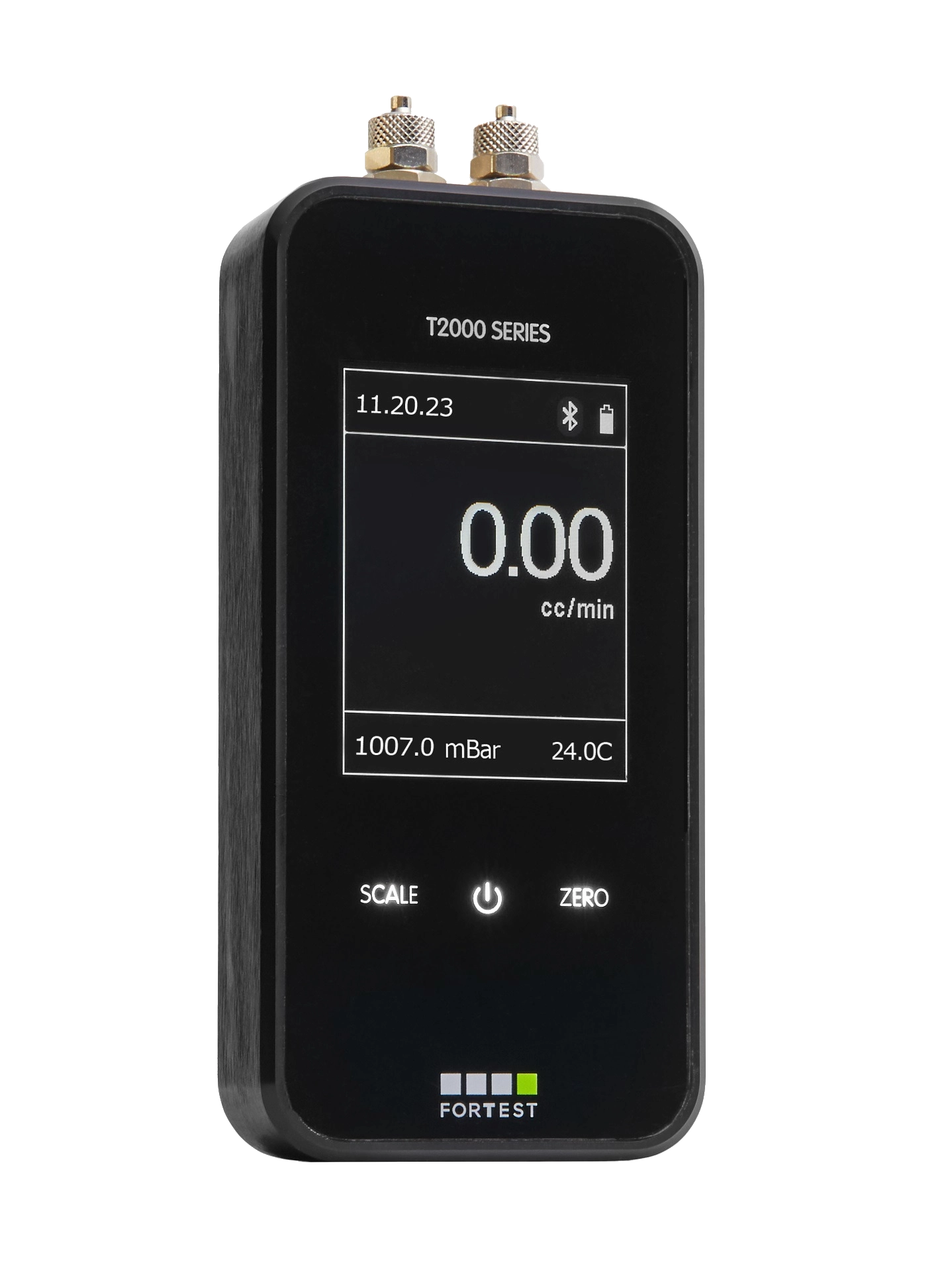
Complementarity with the T2710 for complete coverage
The T2730 completes the ForTest portable calibrator range by covering higher flow ranges. While the T2710 is specialized in microflows up to 200 cc/min, the T2730 handles flow rates from 5 up to 20 liters per minute, two orders of magnitude higher. This complementarity allows companies that handle both small and large components to equip themselves with appropriate verification equipment for all their needs. The T2730 finds typical application in testing medium-large automotive components such as radiators, heat exchangers, cylinder heads, intake and exhaust manifolds, turbines, compressors and vehicle air conditioning systems.
Mass measurement technology for high flow rates
Like the T2710, the T2730 also uses a thermal mass flow sensor, but sized and optimized to handle significantly higher flow rates. Mass measurement technology ensures that the detected values are independent of ambient pressure and temperature variations, and are always referenced to standard conditions of 0°C and 1013.25 mbar. This characteristic is particularly important when working with high flow rates, where even small percentage variations in temperature or pressure could translate into significant absolute errors if uncompensated volumetric methods were used. The sensor responds rapidly to flow variations, enabling dynamic adjustments and facilitating micrometric valve configuration.
Three configurations for different applications
The T2730 is available in three versions optimized to cover different application ranges. The 0-5000 cc/min (0-5 l/min) model is suitable for medium-sized components such as high flow proportional valves, industrial regulators, and automotive subsystems. The 0-10000 cc/min (0-10 l/min) model covers the most common requirements in automotive and industrial hydraulics, making it the most versatile in the range. The 0-20000 cc/min (0-20 l/min) model is dedicated to voluminous components or complete systems such as entire air conditioning circuits, large heat exchangers, or groups of components tested simultaneously. All versions maintain the same accuracy of 1% of reading plus 0.1% of full scale, with constant resolution of 1 cc/min.
Robust construction for industrial environment
The T2730 shares with the T2710 the robust construction in anodized aluminum that guarantees lightness, mechanical resistance and protection from the typical stresses of the production environment. The shockproof plexiglass front panel protects the display while keeping it perfectly readable and resistant to scratches and abrasions. The dimensions of 180x150x35 mm are slightly larger compared to the T2710 to accommodate the higher capacity flow sensor, but the equipment remains extremely portable with a weight of 900 grams. It can be easily transported between different work stations, stored in a bag or toolbox, and used directly on the production line without the need to set up fixed installations.
Autonomy and ease of use
The integrated lithium-ion rechargeable battery provides extended autonomy, allowing numerous consecutive measurement sessions to be performed without interruptions for recharging. This feature is essential when inspections must be carried out on production lines where access to electrical power may be inconvenient or unavailable. Lithium-ion technology also offers extended life cycles and no memory effect, ensuring that battery capacity remains high even after years of use. The 128×64 pixel display, while monochromatic, offers excellent readability in all lighting conditions and clearly displays real-time flow values, also indicating the operating temperature that can influence measurements.
Data management and traceability
The integrated USB slave connector allows connection to computers for transferring data recorded during measurement sessions. This functionality is essential for documentation required by quality management systems: periodic verification results can be archived, statistically analyzed to detect trends or drifts, and included in preventive maintenance reports or production process validation files. The optional M Series Manager software provides an intuitive graphical interface for data management, report generation, and integration with corporate databases. Complete traceability of performed verifications is a fundamental requirement for ISO certifications and for successfully passing customer audits.
Applications for flow instrumentation verification
The main application of the T2730 is the periodic verification and calibration of flow test equipment, both those manufactured by ForTest and by other manufacturers. Flow measurement instruments are used in quality control to verify that components such as valves, restrictors, nozzles, and other hydraulic or pneumatic devices deliver the specified flow rate at a given pressure. Over time, these instruments may experience calibration drift due to sensor aging, contamination, or electronic malfunctions. The T2730 allows for timely detection of these issues by performing comparative verifications: a known flow rate is generated through the micrometric valve connected to the T2730, and the reference value is compared with that measured by the equipment under verification.
Flow control of components and systems
In addition to equipment verification, the T2730 can be used directly to measure the flow of real components and systems. For example, it can quantify the actual flow of a proportional valve at different openings to verify correspondence with the design characteristic curve, measure flow through air filters to verify filtration efficiency without excessive pressure drop, or control the nominal flow of nozzles and jets used in washing or cooling systems. These direct testing applications benefit from the portability of the instrument, which can be brought to the component installation site or used on test benches for rapid characterizations without the need for complex fixed equipment.
Masking System Verification and Troubleshooting
An important application of the T2730 is the verification of temporary masking systems used during leak testing on sub-assemblies of complex components. When testing a part of a larger assembly, plugs, masks, or flanges are often used to isolate the portion to be tested. It is essential to verify that these masking systems do not introduce significant leaks that would falsify the test results. The T2730 allows quantification of the masking system’s seal by directly measuring the flow rate passing through it at test pressure. Similarly, in troubleshooting activities on components that have failed testing, the T2730 provides a quantitative measure of the actual leakage, enabling appropriate corrective actions to be determined.
Regulatory compliance and production use
Many technical industry standards specify minimum or maximum flow values that components must guarantee. The T2730, thanks to its certified accuracy and metrological traceability, can be used for compliance verification providing objective and documentable evidence. This is particularly important in regulated sectors such as automotive, where suppliers must demonstrate to manufacturers compliance with specifications through test reports with calibrated and certified equipment. The T2730, supplied with initial calibration certificate, maintains metrological validity through periodic recalibrations at accredited laboratories, typically on an annual basis according to company calibration plans.
Integration into preventive maintenance processes
The T2730 represents essential equipment in preventive maintenance programs for measuring instruments. Periodic verification with certified reference samples such as the T2730 allows for early detection of performance drift before it causes quality issues in finished products. Companies with mature quality management systems typically implement quarterly or semi-annual verification plans for all critical equipment, using the T2730 as a reference master. Historical verification data allows for analyzing drift trends over time, optimizing calibration intervals, and making informed decisions about replacing instruments that show increasing instability. This proactive approach minimizes non-compliance risks and reduces overall costs of measuring instrumentation management.