Safe and effective hydrogen technology
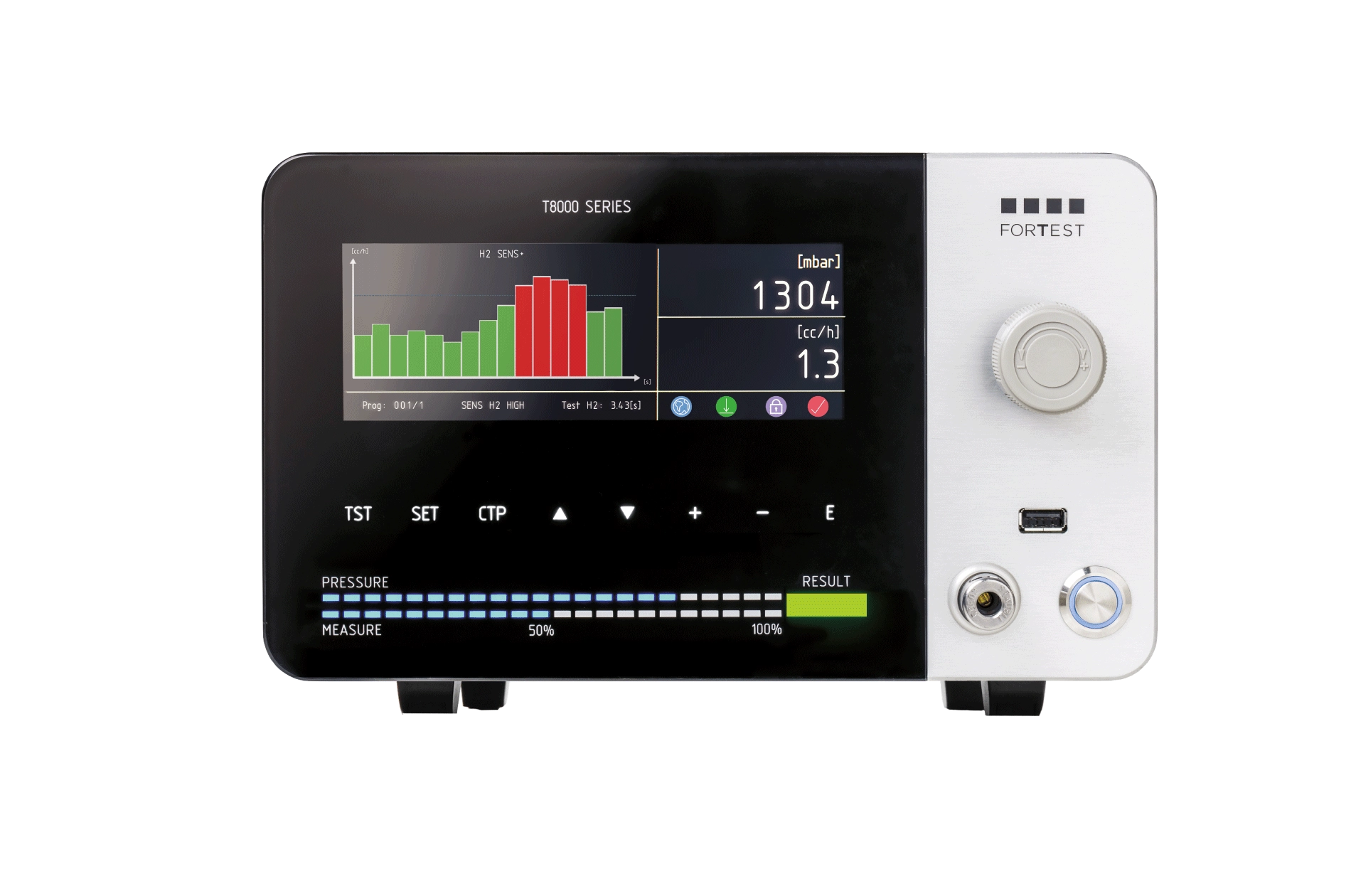
The T8999 represents the modern evolution of leak detection techniques, using hydrogen as a tracer gas. Unlike traditional methods with helium, which are expensive and increasingly difficult to source, or compressed air tests that do not allow precise leak localization, hydrogen offers the perfect balance between performance, safety and economy. The equipment works with forming gas, a mixture composed of 5% hydrogen and 95% nitrogen, which ensures absolute operational safety being well below the hydrogen flammability limit (4%). The sniffer kit supplied as standard allows operators to identify exactly the leak point by moving the probe along joints, welds and surfaces of the component under test.
High-Performance Measurement System
The equipment integrates a dual measurement system: differential pressure (Dp) and direct pressure. The differential pressure sensor covers a fixed range of 0-65 mbar with an accuracy of 0.5% of the reading plus 3 digits, while the resolution varies from 0.001 mbar for lower pressures up to 0.1 mbar for higher ones. This feature allows detection of extremely small pressure variations, correlated to minimal leaks. The direct pressure sensors are available in six configurations (0-1 bar, 1-2 bar, 2-6 bar, 6-10 bar, 10-20 bar, 20-50 bar) to adapt to different application requirements, all with 0.5% full-scale accuracy. The high-resolution acquisition system with 1 million AD points, supplied as standard, ensures maximum precision in signal digitization.
Measurement and Detection Capabilities
The T8999 is capable of measuring leaks in the range 0-10 cc/min with a resolution of 0.01 cc/min and accuracy of 1% of the reading plus 0.03 cc/min. This high sensitivity makes it suitable even for components with very stringent leak testing specifications. In addition to leak measurement, the equipment can determine the internal volume of the component under test, in the range 0-500 cc with a resolution of 0.1 cc and accuracy of 1% plus 2 cc (available for ranges up to 10 bar). Volume measurement is particularly useful for verifying the correspondence between theoretical and actual component volume, identifying any production or assembly defects.
Interface and Programmability
The 800×280 pixel color display offers a clear and intuitive interface for managing all operational parameters. Operators can create and store up to 300 different test programs, each identifiable with a 16-character name for easy recognition. Each program can contain customized parameters for test pressure, stabilization times, acceptance/rejection thresholds, and operating modes. The password protection system prevents accidental or unauthorized modifications, ensuring the integrity of the quality control process. The advanced test archive memory records all test data for complete traceability required by ISO certifications and industry standards.
Integration and automation
The T8999 connectivity is complete and versatile. The dual RS232 ports and RS485 port enable communication with PLCs, supervisory PCs and other industrial devices. The USB Master and Slave interfaces allow connection of printers, barcode readers, memory sticks for data backup. Standard I/O signals include Start, Stop, Filling, Test, Good, Reject and 4BCD for integration into automated lines, while the optional I/O expansion card adds 8 programmable outputs and 4 programmable inputs for complex control logic. The optional Ethernet port enables network connection for remote monitoring and integration into MES systems.
Standard Equipment and Options
The T8999 comes standard with the hydrogen H2 sniffer kit and high-resolution acquisition system. Among the available options are the internal discharge valve, pneumatics for fast filling, electronic pressure regulator, auto-zero circuit, capability to perform both positive and negative tests, automatic pre-filling, pressure reading on standby, and analog output proportional to the leak. Accessories include external solenoid valves, customized push-button panels, start pedals, barcode readers, venturi for vacuum generation, air filters, micrometric valves, thermal printers, and dedicated software such as Data Manager for statistical analysis.
Advantages of hydrogen technology
The use of hydrogen as a tracer gas offers numerous advantages over alternative technologies. Compared to helium, hydrogen is much more economical and readily available, with comparable or superior detection performance thanks to its even smaller molecule. Compared to air tests, the hydrogen method allows not only to quantify the leak but also to locate it precisely with the sniffer, drastically reducing diagnosis and repair times. The forming gas with 5% hydrogen is completely safe, non-flammable, non-toxic and leaves no residue, making the testing process clean and environmentally friendly.
Industrial Applications
The T8999 is employed in various sectors where leak detection and localization is critical. In the automotive field, it is used to test radiators, air conditioning condensers, fuel tanks, brake circuits, heat exchangers and cooling system components. In the refrigeration and air conditioning sector, it is employed to verify the leak tightness of evaporators, condensers, compressors and refrigeration circuits. The hydraulic industry uses it for valves, cylinders, pumps and high-pressure circuits. Other application areas include the medical industry (respiratory circuits, oxygen cylinders), the gas sector (meters, regulators, fittings), electronics (hermetic packages) and aerospace (pressurized components). The versatility, sensitivity and localization capability make the T8999 an indispensable equipment to ensure product reliability and safety.